
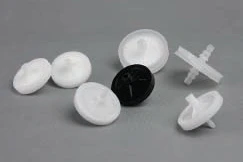
Biological Liquid Handling
Laboratory Liquid Filters
Select filters for laboratory fluid handling based on the liquid, volume and tubing connections.
Multiple media optionsExplore ↗
LABORATORY / Biological Liquid Handling
Coordinate the vessel and vacuum source with filtration area, volume and membrane compatibility.
Images and specifications refer to the indicated models. Contact us to confirm configuration and suitability.
A vacuum filtration unit combines an upper reservoir, membrane and receiving container. Vacuum on the downstream side drives liquid through the membrane directly into the receiver. It is useful for batch preparation of aqueous laboratory fluids. Reservoir capacity describes how much can be loaded, while membrane area, viscosity and particulate loading determine practical throughput; foaming and volatile components also need consideration.
| Selection factor | What to compare |
|---|---|
| Assembly format | Complete units simplify collection; separate funnels require compatible, vacuum-rated receivers. |
| Membrane | Compare recovery of proteins and additives alongside analytical background. |
| Capacity and area | Reservoir volume governs loading; membrane area and fouling govern processing time. |
| Category | Biological Liquid Handling |
|---|---|
| Material options | PES / other media |
| Filtration objective | Define what to remove and what to retain |
| Rating / Dimensions | Confirm combinations against controlled model specifications |
| Flow / Temperature / Pressure | Specify normal and limiting operating conditions |
| Connections / Seals | Confirm installation interfaces and wetted materials |
| Cleaning / Validation | Confirm the service cycle and acceptance criteria |
These are selection inputs, not verified performance claims for a specific model.
Use the worksheet to collect your operating conditions. Contact us for controlled datasheets, dimensional drawings or validation documents for a specific model.
Product selection worksheet · TXT ↓Request technical documents ↗Use vacuum-rated vessels and appropriate protection against liquid entering the vacuum source.
Observe liquid level and foam, preventing receiver overflow into the vacuum line.
Release vacuum according to the device procedure before disassembly and promptly close the receiver.
It may worsen foaming or exceed vessel limits without solving membrane blockage.
That depends on the specific membrane grade, assembly condition and validated handling process.
RELATED PRODUCTS
Select filters for laboratory fluid handling based on the liquid, volume and tubing connections.
Specify vessel configuration, surface treatment, cap ventilation and working volume for the culture method.